| |
|
|
|
|
| ENVIRONMENT PROGRAMS |
|
|
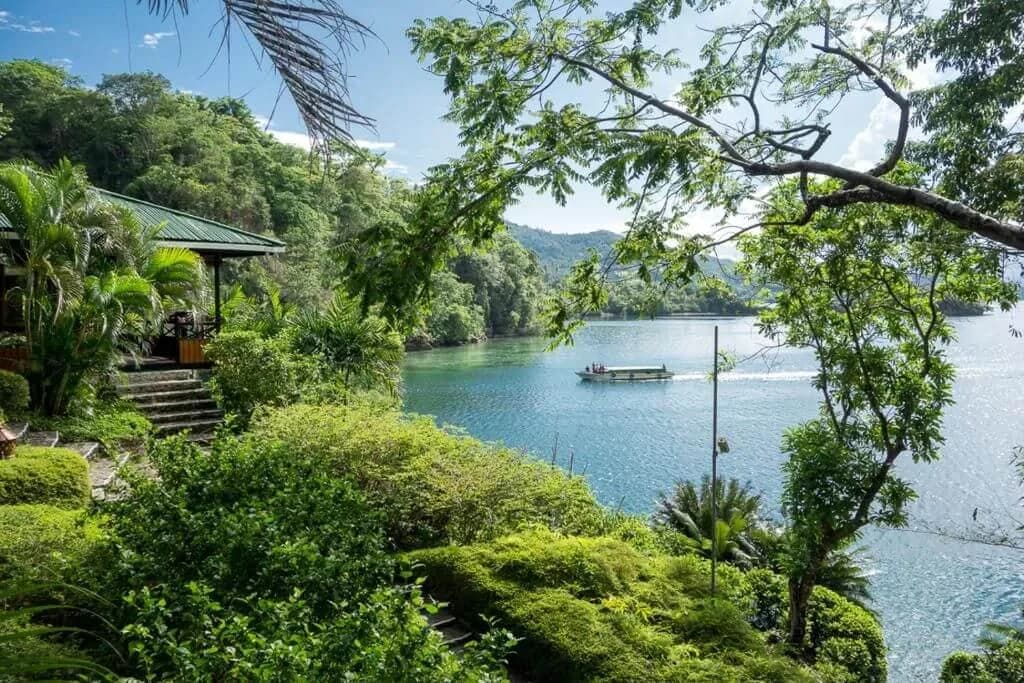
| Introduction Lembeh Resort is located on the Lembeh Island side of the Lembeh Strait, famed for its critter diving. The resort is situated in between two cliffs in a wide bay. There is a village on either side of the cliff adjacent to the resort. The house reef in front has a lot to offer, but had also been in some parts destroyed in the past either by anchoring or by storm or both. These destroyed areas are the current sites of our house reef project. |
|
| Method We have started this project in February 2007, by testing a few different methods of habitat restoration (adding structure to the house reef area). We have started by placing a different sized cement blocks and transplanted small coral fragments onto them. The first method of attaching the coral fragments was epoxy glue, which did not work for our purposes. The epoxy is great marine glue, but not for attaching the sensitive and already stressed coral fragments. Firstly, the mortality of these fragments was high by bleaching. Secondly, the fragments simply attached by the glue were easily broken off by the actions of less experienced divers with no chance of replacement.
Second step was using galvanised steel sticks, which we build into the blocks. Fragments were attached to the sticks by cable ties. This method of attachment is much easier for the working divers, corals are doing well and the mortality of the fragments dropped right down. The drawbacks were the cost of the material: cement and galvanized steel; and strenuous placements of the blocks.
To elaborate on the already placed blocks, we stacked them up into fish houses and by that we achieved two aims: There were elevated structures added to the rubble areas, which provided a fish retreat and protection, we also kept the transplanted colonies in place, which lifted the small coral fragments higher up in the water column. The method of fish houses can be easily elaborated on by placing different materials in different shapes.
By October 2007, the central and northern house reef project sections have been completed and 50 concrete block structures of different shapes have been transplanted with coral fragments. The concrete structures began to attract a number of benthic species, which started to colonise the blocks. All the structures started to closely blend to the surrounding environment. Many juvenile fish found a refuge under the structures and nudibranches seem to favour the concrete as an ideal substrate to mate and to lay their eggs on.
There is a list of options for different structures or substrates you could use to elaborate on these. The main concerns to you if you would like to place out different structures should always be their eco-friendliness, effectiveness and purpose and nevertheless their esthetical impact.
We also installed three BioRock©s to date. First, The Tunnel was placed out in April 2007, second, The Blob, in December 2007 and third, the Pagoda, in February 2008. Biorock is a metal structure to which low electricity current is led to promote calcium carbonate deposition. Calcium carbonate, being the coral building material enhances the growth rate of corals and other sessile organisms attached to this structure. Most of the transplanted corals, branching, massives and plates are doing well and we can start to see some increased growth from the original colonies. So far the biorock shows very high survival of coral colonies and starts to attract further benthic settlement.
Another addition to the house reef project was sinking of a 15 meter wooden boat onto the deeper part of the reef. It sits on the sandy bottom in about 24 meters of water. The wreck was sunk in December 2007 and it was purposely sunk quite deep, to attract attention to the deeper part of the house reef. We would like to bring back some of the large predatory fish species back to the area. Since the house reef it has been freed from fishing since the resort opened in 2003 (purely an unwritten rule), the wreck serves as a refuge for the sought after market fish (cods, snappers, sweetlips). Again this can be elaborated by sinking bigger wooden boat along the sandy slope.
In addition to that, we have placed two squid ropes on either side of the wreck and laid down ropes on the ground. You should check on these regularly. Squid ropes are there to attract squid lying eggs. Ropes on theground are there to attract critters like frogfish, seahorses or tozeuma shrimps, who like to seek a shelter on ropes. |
|
|
|
|
|
|
A biorock is basically a growing, “living” metal structure underwater to which low voltage electricity is connected. The electric fled surrounding the metal structure promotes CaCO3 (limestone) growth on the metal, and with time the structure grows larger and larger, the same way that coral grows.
In order to construct a Biorock, you will need material for the BioRock© itself, most preferably the cheapest not galvanized metal bars or rebar’s, it is no need to use expensive metal. In any case do not use aluminium for any part of the structure as it will dissolve.
Secondly, you will need anode, to which the positive current is led. Anode on the other hand cannot be any other metal than titanium. Titanium mesh (quite costly, $50/m2) will not dissolve, as led or steel would, it is permanent and will last for years and years and it is non toxic.
Third you need a cables, triple isolated, 2.5mm2 cable. You have to go to Manado to buy these; do not trust the stores in Bitung. Also always double-check the thickness, you cannot return anything in Indonesia. The way we connect the cables is one whole cables (negative, positive and ground) one attaches as negative and one as positive source.
You will need epoxy marine glue to connect the cables to the anode and to the structure. Also you will need to make a connection in the cables if they do not reach all the way to the Biorock. Obviously, little connections you make, lesser the space for error so try to use as long cables as possible or and place the Biorock close enough to the shore.
The way the Biorock work is pretty simple, seawater creates an electric field. By placing the anodes on either side of the BioRock, you will create even limestone deposition. The size of the anode should be about 1/20 of the size of the structure, but this is only educated guess, there are no strict rules.
Distance from the shore is your limit, if using a battery charger, the DC current running through is only effective for about 100m, assuming you are using at least 2.5mm2 thickness cables. Anything further away from shore, solar panels should be used. If you could use an underwater AC/DC converter, the distance would be no limit. In areas suitable for that tidal or wind power can be used. |
|
|
|
| Benefits of the BioRock There is some discussion about the effectiveness of the BioRock but here is the list Tom Goreau (www.globalcoral.org ), one of the finders of the methods gives you:
* Corals transplanted onto the structure show 3-5 times faster growth
* There is up to 20 times faster healing process of corals, indicated by lesser or no mucus secretion
* 16-20 times better survival in elevated sea temperatures (this is based on BioRocks build in the Maldives before the mass bleaching in 1998)
* Higher settlement of coral larvae
* Fish attractors
These are all only observation of his and his colleges. There has not been publishing in a scientific paper proving any of this yet.
From our personal experience: the BioRock is an ideal method to create an extra habitual structure to an area, coral transplanted onto it does grow and the mortality is very low, comparing to other methods such transplanting corals onto fish houses. We also try to choose corals laying loose in the substrate or colonies partly attacked by a predator (coral eating sponge); generally we pick corals, which are more prone of dying in their original place. By lifting the corals up, we gave them better position to photosynthesize and we assume they have a better chance to survive and to grow. Fish are naturally attracted to structures for protection and the Biorock is no exception. |
|
| NOTE: If you take a coral colony attacked by the coral eating sponge break of the healthy part of the colony and make sure none of the sponge is left.
To know if the settlement is higher or and if the corals are growing faster, we would have to do an experiment, which we have not done. The limestone coating on the structure is less than we expected, but since we have three BioRocks attached to one battery charger already; the cause is lower electricity.
Note if you planning to construct a fourth BioRock, you need to buy a new battery charger and place out two new anodes.
The amount of the current run to the structure determines the type of deposition on the biorock. If you overcharge the biorock, you will grow magnesium (Mg), instead of calcium carbonate (CaCO3). Magnesium is two times more abundant in the seawater than limestone, but it is much softer and it won’t thicken the biorock nor promote the coral growth. The consistence is also muddier and will come off when touched. If you run the current very slowly, you won’t achieve that fast limestone deposition but you will enable natural settlement of coral spats. After we connected the new Biorocks the Blob and the Pagoda all connected to one charger, we started to see natural settlement of corals. Medium current running to the biorock grows the structure relatively fast, but fast enough to overgrow any coral spats, so you won’t get any successful natural settlement.
In the conclusion, the BioRock are success. They are interesting shaped structures, placed on a field of rubble, where they attract vast array of fish species. The corals grow well, the mortality is low, and we observed first naturally settled coral colonies starting to grow on the structures.
These is the recommended way of elaborating on the house reef project or and expanding it to new areas. |
|
| Biorock maintenance In order to check if the biorock is functional, there are three main things that should be checked:
1. Check for small bubbles emerging from the structure.
2. Make sure that the anode is in an upright position and not overgrown by algae
3. Check that the battery charger is delivering 12v electricity with approx. 20 amp resistant.
|
| Naturally, corals do die. If many transplanted fragments are dead, collect new fragments and attach to the biorock with wire.
Note: all the coral will die if you accidentally switch the positive/ negative charge. Therefore mark the Anode and be careful!
|
|
| HOUSE REEF RESTORATION PROJECT |
|
|
|
Click here to download the House Reef Restoration Project Report - by. Lindsey Dougherty (Adobe Acrobat file, 830 kb). |
|
|
|
|
|
PLEASE NOTE - - LEGAL NOTICE: All photographs contained on this web site and photo galleries within site are protected by international copyright laws. None of the images you see here are in the public domain and remain exclusively the copyright of Photographer noted and or Lembeh Resort. No image is to be copied, duplicated, modified or redistributed in whole or part without prior writer permission. THANK YOU and enjoy our web site designed by ScubaVision |
|
|